World Situation
Dengue is currently one of the most rapidly spreading mosquito-borne viral diseases in the world and represents a major global public health challenge. The disease is caused by four dengue virus serotypes (DENV-1, DENV-2, DENV-3, and DENV-4) and is transmitted mainly through the bites of infected Aedes aegypti and Aedes albopictus mosquitoes
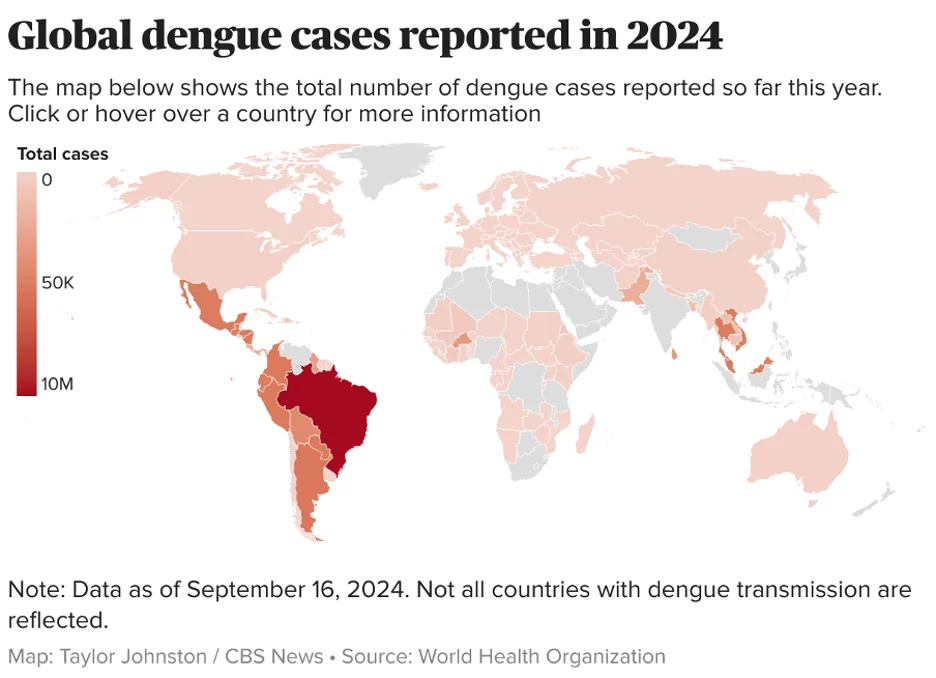
According to the World Health Organization (WHO), dengue incidence has increased dramatically over the past two decades. Reported cases globally increased from approximately 505,000 cases in 2000 to more than 14.6 million reported cases in 2024, representing the highest number of dengue cases ever recorded worldwide.
WHO estimates that approximately 390 million dengue virus infections occur annually worldwide, of which around 96 million manifest clinically with varying degrees of severity. Recent global estimates further indicate that nearly 5.6 billion people living in 129 countries are currently at risk of dengue and other arboviral infections.
In 2024, WHO reported more than 14.4 million dengue cases globally, including over 7.7 million laboratory-confirmed cases, more than 52,000 severe dengue cases, and over 11,000 dengue-related deaths across all six WHO regions. The WHO Region of the Americas accounted for the majority of the global disease burden, with countries such as Brazil experiencing exceptionally large outbreaks. Significant outbreaks were also reported in South-East Asia and the Western Pacific Region.
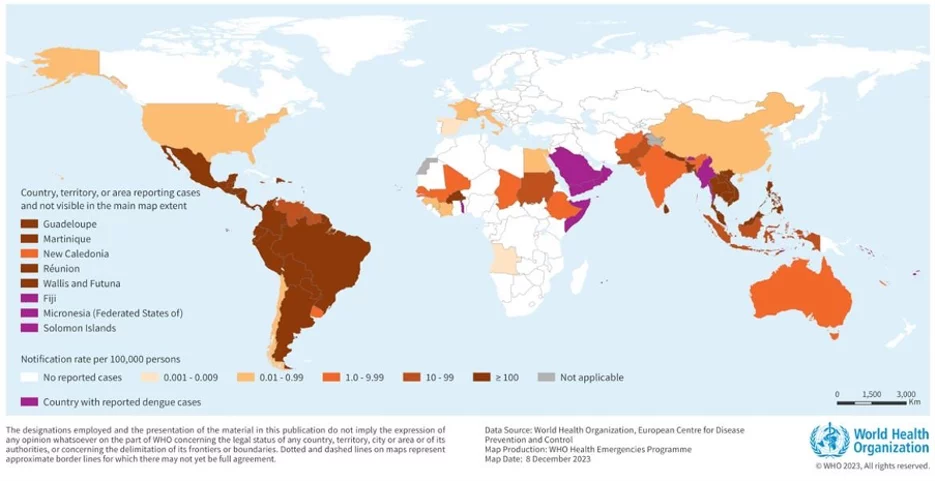
Dengue is now endemic in more than 100 countries across tropical and subtropical regions, including many countries in Asia, the Pacific, the Americas, Africa, and the Eastern Mediterranean Region. Furthermore, dengue transmission is increasingly being reported in previously unaffected regions, including parts of southern Europe. In 2024, locally transmitted dengue cases were reported from France, Italy, and Spain.
Several factors have contributed to the rapid global expansion of dengue. These include rapid urbanization, population growth, increased international travel and trade, inadequate water management, poor waste disposal practices, climate change, rising global temperatures, changing rainfall patterns, and the expanding geographical distribution of Aedes mosquitoes. Climate variability and extreme weather events have further intensified dengue transmission in many countries.
Clinically, dengue infection may range from asymptomatic infection or mild febrile illness to severe dengue characterized by plasma leakage, severe bleeding, shock, and organ impairment. Severe dengue can rapidly become fatal if not recognized and managed promptly. However, with early diagnosis, appropriate clinical monitoring, and timely supportive management, dengue mortality can be reduced to below 1%.
The World Health Organization emphasizes integrated dengue prevention and control strategies, including strengthened disease surveillance, laboratory confirmation, vector surveillance and control, community engagement, outbreak preparedness, risk communication, and timely clinical management to reduce dengue-related morbidity and mortality globally. (World Health Organization)